
Title: Spook: Science Tackles the Afterlife
Genre: Nonfiction (Dewey number 129)
Subject: Afterlife, death and paranormal phenomena
Type: Science, Spirituality
Publication Date: 2005
Number of Pages: 295
Geographical Setting: various
Time Period: various
Plot Summary: What happens when we die? This is the fundamental question Roach’s book explores. However, this book is not meant to debunk or prove definitively the existence of an afterlife. From the introduction Roach writes “this is not a debunking book. Skeptics and debunkers provide a needed service in this area, but their work more or less assumes an outcome. I’m trying hard to not to make assumptions, not to have an agenda. Simply put, this is a book for people who would like very much to believe in a soul and in an afterlife for it to hang around in, but who have trouble accepting these things on faith” (14).
The book covers a wide period of time from the early Greek and Hebrew philosophy scholars to the present day. Some of the topics explored include reincarnation, theories on when the soul enters the fetus, experiments to prove the existence of a soul such as weighing a person at the moment of death, ectoplasm and aura photography, spiritualism, medium school, parapsychology, and various ways people try to communicate with the dead.
The book is written humorously and is in the middle of Wyatt’s narrative continuum scale. Most of the book is written factually with little dialogue. The only parts that contain actual dialogue are from the author’s direct experiences. Her tone is witty, sarcastic and dry. Here’s a sample quote: “For three hours and forty minutes, the physicians watched the man fade. In place of the more usual bedside attitudes of grief and pity, the men assumed an air of breathless, intent expectancy. I imagine you see this on the faces of NASA engineers during countdown and, possibly, vultures” (Roach 81).
Top 3 Appeals: Learning/experiencing, tone, story line
 Read alikes:
 Ghostland: An American History of Haunted Places by Colin Dickey: This book explores some of America’s most haunted locations and the true history behind their most famous ghost stories.
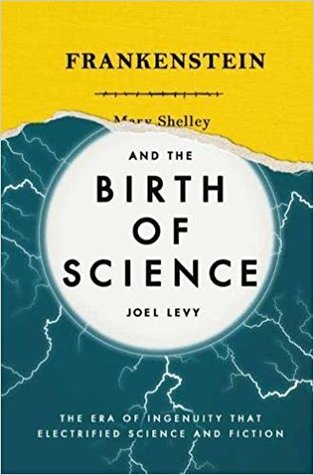 Frankenstein and the Birth of Science: The Era of Ingenuity That Electrified Science and Fiction by Joel Levy: This book explores the science of the time and how it influenced Mary Shelley when she was writing her iconic book Frankenstein.
 References:
Roach, Mary. Spook: Science Tackles the Afterlife. W.W. Norton & Company, 2005.
Wyatt, Neal. The Reader’s Advisory Guide to Nonfiction. ALA, 2007.
“Read-alikes for Spook”. Novelist, http://web.a.ebscohost.com/novp/detail?sid=d9e05ae9-1123-435c-81f0-2bc203963ded%40sdc-v-sessmgr03&UI=UI+159144&vid=12. Accessed 27 March 2019.
All images taken from Goodreads.
Yay! A nonfiction choice that isn't a memoir about mental illness! It does sound irreverent and sarcastic (like many of our choices so far, I think?), maybe that will be the overriding tone of this age and when historians look back they will wonder. Maybe they won't wonder, and maybe that will be worse. This book sounds interesting, though--did it come to any surprising conclusions?
ReplyDeleteThere isn't much better than a sarcastic book on life after death! Well maybe a sarcastic book on life before death...:)
ReplyDeleteI am such a fan of Mary Roach's work! I haven't read this title yet, though...but is definitely on my to-read list. I love the way she can make any subject interesting to read about, and humorous. My favorite kind of nonfiction!
ReplyDeleteOkay this sounds like a book I would enjoy!! Death with humor is always fun mix. I haven’t read any books by Roach before, but I’ll have to check her out!
ReplyDeleteI LOVE Mary Roach! Tomorrow evening my book club is discussing Gulp by her! She does a great job mixing science and humor and making it into fun and easy non-fiction reads. I love that you included a quote of her writing style. Full points!
ReplyDelete